
Project Overview:
This blog describes how a furniture manufacturing company improved its sales tracking by using Salesforce automation. This change enabled reliable forecasting, better accountability, and real-time insights.
In the made-to-order and bulk furniture business, tracking sales accurately is crucial. With long deal cycles, customized orders, and a distributed sales team, leadership needs clear month-wise visibility into booked revenue and pipeline performance down to each sales representative.
The Business Challenge: No Structured Goal vs Actual Tracking
The sales team had monthly targets, but tracking performance was mostly manual and inconsistent.
Key challenges included:
– Booked goals and pipeline goals were shared offline and not tracked systematically.
– Actual performance was calculated manually from Opportunities.
– High risk of errors and delays in reporting.
– No real-time visibility into:
– Closed-Won performance.
– Open pipeline coverage.
– Performance reviews and forecasting were reactive and time-consuming.
As a result, leadership lacked transparency, forecasting accuracy suffered, and sales reviews relied heavily on spreadsheets.
The Salesforce Solution: Automated Monthly Performance Tracking
To tackle these issues, the organization started a Salesforce initiative focused on structured goal vs actual tracking.
The solution included:
– Standard Salesforce Opportunity data.
– Custom objects for monthly tracking.
– Salesforce Flow for automation.
– Dashboards and reports for visibility.
Custom Monthly Performance Framework:
A Monthly Performance record was created for each sales representative for every month. This record became the single source of truth for goals and actual performance.
- Booked Goal (Manual Entry)
- Monthly target for Closed-Won deals.
- Entered by sales managers.
- Stored on the Monthly Performance record.
- Supports planning and accountability.
- Booked Actual (Automated)
- Automatically calculated using Salesforce Flow based on:
- Opportunity Stage = Closed Won.
- Close Date within the selected month.
- Opportunity Owner = Sales Representative.
- Automation Benefits:
- Real-time updates.
- No manual calculations.
- Accurate total of booked revenue.
- Pipeline Goal (Manual Entry)
- Target pipeline coverage for the month.
- Represents expected open deals closing in the same month.
- Helps align sales planning and forecasting.
- Pipeline Actual (Automated)
- Automatically calculated using Salesforce Flow with criteria:
- Opportunity Stage = Open.
- Close Date within the month.
- Owned by the respective sales rep.
- This provides a live view of pipeline health at any point during the month.
- Reporting & Dashboards: Complete Visibility
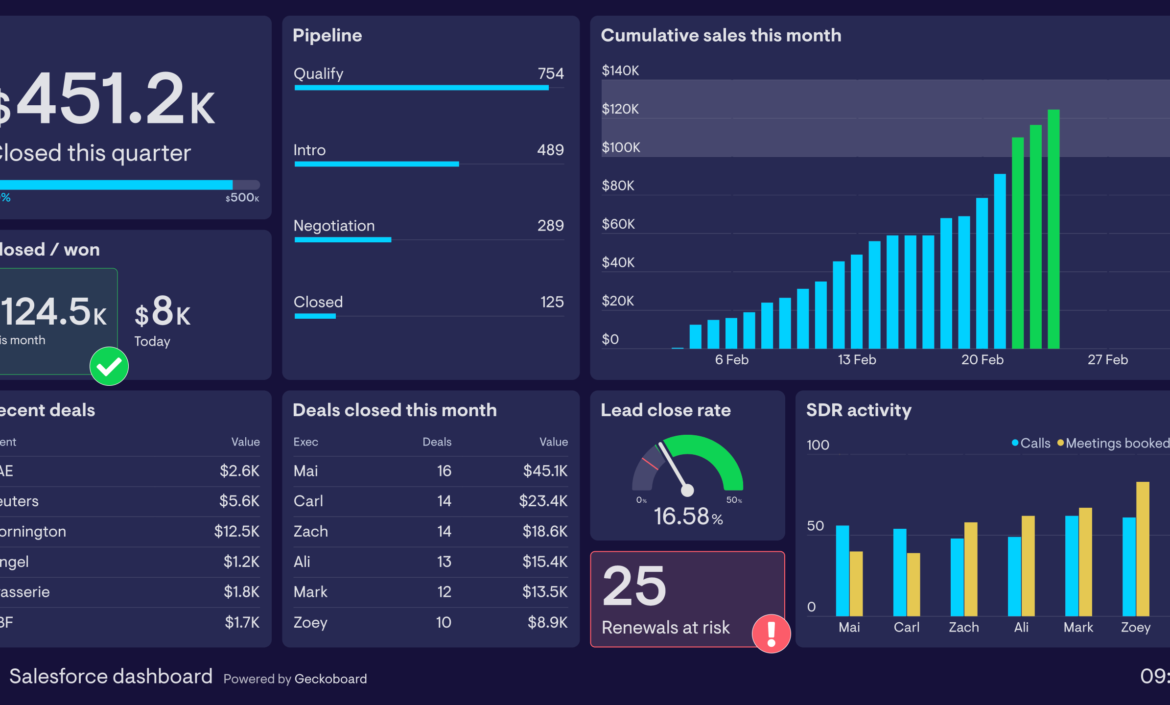
- Unified Salesforce dashboards provided:
- Booked Goal vs Booked Actual.
- Pipeline Goal vs Pipeline Actual.
- Month-wise and rep-wise performance.
- Unified Salesforce dashboards provided:
- Automatically calculated using Salesforce Flow with criteria:
- Automatically calculated using Salesforce Flow based on:
Managers could now:
– Identify gaps early.
– Take corrective actions mid-month.
– Improve forecast accuracy.
Business Impact & Results
– A single source of truth for sales performance.
– Elimination of spreadsheets and manual calculations.
– Real-time visibility for booked revenue and pipeline.
– Improved forecasting accuracy.
– Clear accountability for each sales representative.
– Faster, data-driven performance reviews.
Final Thoughts
By implementing structured goal vs actual tracking with Salesforce automation, the furniture manufacturer gained clarity, control, and confidence in its sales operations. This approach is scalable and suitable for organizations looking to shift from reactive reporting to proactive sales management.
If your sales team still relies on spreadsheets for monthly tracking, this type of Salesforce design could be a game-changer.


